Showing posts with label Homeschool. Show all posts

Wednesday, February 10, 2016

Learning About Craft Businesses

A local homeschool group puts together a craft fair every fall. Anyone can sell at it, but it's particularly a chance for kids to experience a bit of entrepreneurship -- developing a product, organizing, pricing, advertising.

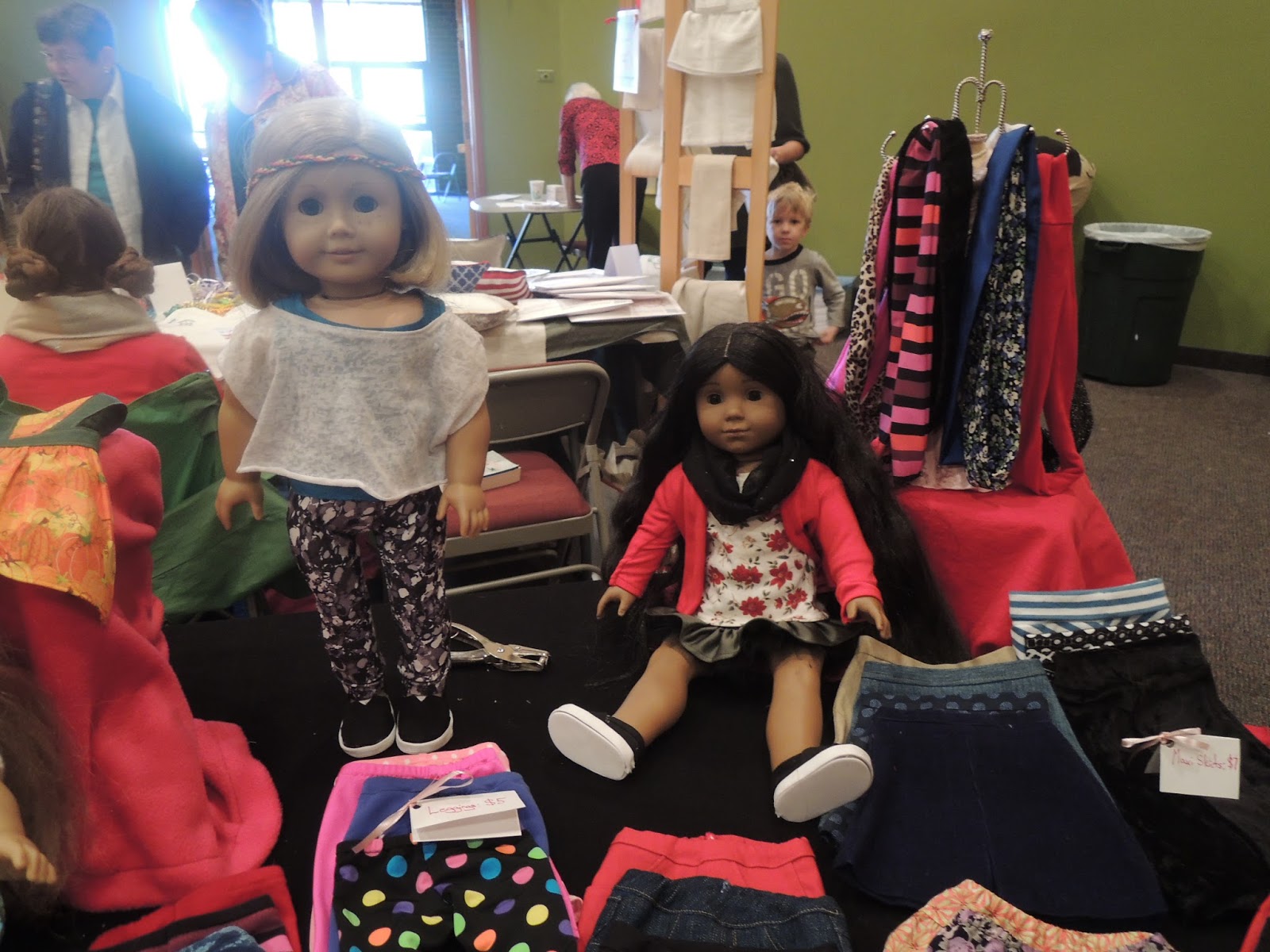
Annabeth and I decided to purchase a space to sell doll clothes, having discovered people would actually pay money for things we make.


 We made sure we had a lot of items at a lot of price points.  It was sort of crazy here in the weeks leading up to the craft fair, as a matter of fact, as we made clothes and shoes, figured out pricing, rehearsed efficiently setup of our display.  We also signed up with Pixie Faire to sell  items made with their patterns -- an easy process, but someone actually did ask if we had permission to sell items using these patterns, so hooray for being official.


Oddly enough, someone also asked if the clothing would actually fit the dolls.  We had, of course, tried each item on a doll at home as soon as we finished making it.  More to the point, though, we had 6 dolls standing or sitting at our booth wearing various outfits; and during the course of the day Annabeth had small girls help her decide on new outfits and participate in re-dressing the dolls.  

The oven mitts were popular.  We should've made a bunch to sell as Christmas ornaments.  Pattern from Lee & Pearl.

Annabeth wants to continue selling the overstock plus some new items.  The biggest barrier is letting people know what we have.  Attend more craft fairs?  Use social media?  She's been working on photographing various outfits. 


She has strong opinions on what what constitutes good doll photography.


I think she's starting to get the hang of it.

Monday, February 8, 2016

School desk upgrade

One issue with blogging much about homeschooling a high school student is that the choices in education become so highly individual by this point.  Gone are the days of general discussion of phonics vs. whole word, or spiral vs mastery.  High school is the realm of a child who might be deciding whether or not to dual enroll several semesters of calculus vs. a child who might be figuring out how to run their own business. I really think that's a big reason why so little is written about how to homeschool high school (well, and by the time you get to high school you're so busy with the actual homeschooling that you don't have a lot of time to write about it, let alone find anything interesting to photograph).

However school is accomplished, though,  a unifying element for all students is the need for an area for writing and/or computer.  For Ananbeth, a huge fan of Katy Bowman, this involves sitting or lying on the floor. 

This year for Christmas we found the perfect desk for her:

a bamboo bed tray (shown here on Christmas morning with treats from the stockings -- potato chips and juice).

It's easily portable, so she can take it to various rooms of the house or carry it out to the porch. It fits her laptop nicely. The top can adjust to tilt various angles, but so far she hasn't been interested in using that feature. 

Theoretically it will hold up well enough that she can still use it when she moves out into her own place, which will probably not have furniture.


Tuesday, May 27, 2014

Since last time ...

Let's see ... lots has happened.

Driveways and walks were shoveled repeatedly.  Cold was survived.

Braces came off.


Another show, which probably deserves another post.  


More colleges were visited, and some colleges were visited more.  Auditions and portfolio reviews happened.  A final choice was made, and deposit deposited.  Plus a graduation.


Co-op came to an end, and disbanded.  We were really done with it this year.

Family members got sick and got better.  A fender was bent, then repaired.  A filling flew out of a mouth while flossing.  People came to visit; some spent a night or two.

And other stuff.  Life went on.  Homeschooling was accomplished.

Which brings us up to date.  Sort of. 

Friday, February 1, 2013

Midyear Homeschool Snapshot

Last semester Thalia took 2 classes at a local university as a dual-enrolled student.  One was a basic English class that included studying grammar, writing essays, and doing some presentations. She's done with English for the year (in general, a semester-long college class is equal to a full credit of high school -- there are exceptions, of course).  The other was Spanish 1; she's taking Spanish 2 this semester, so she'll have 2 full credits of Spanish by May.

She's taking a year-long Chemistry class that a retired chemist is teaching in his basement lab.  He's teaching 2 classes this school year, each one meeting one day per week.  A few of the kids dropped out at the end of the semester, saying it was too hard.  On the other hand, when he emailed Thalia her semester grade over Christmas he included something to the effect that he hoped he could make the class challenging enough for her.  Not that she's some super-genius in chemistry, but the Kinetic Physics - Principles of Physics she took last year was so rigorous that now chemistry seems easy-peasy.  Also, I have the impression that chemistry makes a lot more sense if you've already had physics (I took it the other way around in high school, but I can see the logic of physics first if you've taken enough math to accomplish it).

Health class is taught at the co-op we attend.  The woman teaching it is a nurse, and a believer in the more-is-more philosophy of homeschooling.  Quick background on why I say that: Missouri requires public schools to provide 7,830 minutes of instruction per credit, according to this pdf from the Dept. of Education and Secondary Education -- if you do the math, that's 130.5 hours.  On the other hand, the same website, different page tells us that a homeschool high school credit is 100 hours.  The co-op health teacher has decided to go with the higher standard, and cramming a LOT of info into the half-credit class.
 
The book they're using is Total Health.  Thalia's commentary yesterday while reading the book:
"Why is the word another even in this sentence - it doesn't make sense.  This reads like it was written by an English as Second Language student who had a dictionary but didn't really know what the words actually mean;"
[Reading this is] "like watching a trainwreck - you just can't bring yourself to look away;"
"This is why people don't want to become Christian - because they see stupid stuff like this and don't want to be involved."

So, in summary, she loves the teacher but scorns the book.  No word yet on whether it will replace Apologia as her most despised textbook, but it seems to be in the running.

We also purchased a Thinkwell AP Government course when they were on sale at Homeschool Buyer's Co-op, and she's working through that.  I'm not sure yet if she'll take the AP exam in May.  Thinkwell has 3 lecturers for the course, who have different presentation styles.  This works well from the standpoint that if you dislike one, that person is only there for part of the time.

Math is done here at home.  This year is Pre-Calc, using Lial's.  It's a long slog.

Annabeth is using Lial's Basic College Math as a pre-algebra text.  Sometimes the questions are about things she has no experience in, such as whether $18.76 seems like a plausible car payment.

She continues to work on History Odyssey Middle Ages Level 2, from Pandia Press.  Once this is done we will be done with History Odyssey -- she's developed an intense dislike for the program.  She finds the assignments to be lame.  I could go through and reformulate all of the assignments, but if I'm going to do that I might as well save my money and start from scratch with a different spine than Kingfisher History Encyclopedia.   She's quite close to the end, so we need to figure out the next thing soon.

One nice thing about History Odyssey is that it requires quite a few essays, and can count towards a writing class.  English for Annabeth is rounded out with Analytical Grammar.

Annabeth is taking ASL at co-op.  She really enjoys the class.  She's also taking Interior Design there, which she complains about constantly -- this is the spring segment of Home Ec, which covered sewing in the fall. The class has too much lecture and too few projects for her taste.

Her science class is CPO Earth Science, which I'm teaching at the co-op.  It's a reasonably fun class, and I think she's learning quite a bit.  I really like CPO, and I think she does, too.  But I really dislike teaching an entire class of middle schoolers.  There are only 9 kids.  I try to include things that are only doable with a group of 9 rather than home alone, but, still, gah.  I'd rather be home alone.


Saturday, September 22, 2012

Flashbacks

Sometimes you really question your choices in homeschooling, partially because there are just so very many choices to make.  Which subjects to cover, which curriculum to use for each subject, how much time to spend on each subject (both per day and as a cumulative total) ... down to nitpicky details like which type of paper to use and how to teach pencil grip.  I've seen knockdown drag-out fights online  in regards to pencil grip.

And then every once in a while you get some sort of validation.  This week we had a couple of those moments.

Thalia is taking Spanish at a university, and I had heard that this was really a bad idea considering she's only piddled around with the language before this -- she was doomed to being unable to keep up since she hadn't actually studied it as a school subject before.  But she's really doing alright.  She commented the other day that part of what makes it easy is all of the Latin we did.  Not that we ever completed any particular program, and not that any of us have any fluency in Latin whatsoever.  However, she remembers conjugating Latin verbs, and the little charts I made to show the conjugations (which I based on how I learned to make charts in Spanish class, by the way).  So now when they conjugate Spanish verbs in class she realizes things like "just leave off the t in 3rd person [Latin] and you've pretty much got it."

Apparently our slovenly approach to learning non-English languages accomplished something.

Her dual enrollment English class is going well, too.  Whenever she has a question about a part of speech she diagrams the sentence, and that clarifies things in her mind.  I never learned to diagram.  Frankly, I barely learned any grammar in school at all.  But Susan Wise Bauer assured us (via her books and articles) that learning to diagram would be a good idea.  So we did, using Rod & Staff English, First Language Lessons, and, finally, Analytical Grammar.  And now, years later, Thalia is earning extra credit for speed and accuracy in her ability to analyze a sentence.

It might be enough to go to a homeschool parent's head, you know?  Except then all of these discussions of past curricula made me nostalgic for those early days of homeschooling, and I started looking through old photos....

Oh, look, an archeological dig!


And hieroglyphics!

Dying cloth purple, just like in Tyre!

Yeah, we've got tons of photos from studying ancient history.  We also have tons of maps we drew of the various countries.  We were using Story of the World, including the Activity Book -- if you've used it you know what I mean.  Do you want to know how much the kids retained of this?  Almost nothing. They remember the time we recreated the burning of London in the driveway and Annabeth was so excited that she tripped over something and bloodied her nose when she fell.  It's like all of those maps, not to mention most of the projects, never happened. Sigh.

It's sort of like we've been throwing stuff against the wall for the past 10 years and seeing what sticks.

Other notes from the homeschooling trenches:


Saturday, September 15, 2012

This Week in Homeschool

Thalia:  "It seems like I have less homework this year, but I also have less time."

The "less homework" is due to shorter, more intense classes.  The "less time" is because we spend so much time in the car.  Which brings us to the Big Question of the Week -- how can we better utilize the time we spend getting places?

(The Small Question of the Week was whether Annabeth needed to do the long division section of Lial's Basic College Math given that she liked and understood the RightStart way of doing long division.  That one was solved by doing the section test to see if she really was proficient.)

We have somewhere to go Every Single Day.  Not all of us go someplace everyday, but someone always has to be somewhere, and it's usually at least 20 minutes away.  That adds up by the time you get there and get back home.

Plus we end up with these odds and ends of time -- "we're going to leave in about 10 minutes" translates into "well, sheesh, it really probably isn't worth trying to wash the dishes/grade the math/get out the vacuum in that amount of time".  (Although, really, is it ever worth getting out the vacuum?  It's pretty much in permanent last place on my list.)

We kicked around the idea of doing audiobooks in the car.  One issue with that is the passenger list varies so much.  At any given time there might be 1, 2 or 3 people along for the ride.  And during the course of a trip, 1 or 2 passengers might be dropped off or picked up.

Maybe load books on the iPod so we can plug it into the car's sound system, and then click to different books according to who's in the car.... Seems awfully fussy, doesn't it?

Annabeth is always a passenger, so she simply takes along her homework to work on in the car.  Thalia does a lot of the driving, and I do the rest.

I"m really grateful that we live in an area that has so many opportunities. Also, it's great that we can take advantage of so many of them -- we have a car, we have access to relatively inexpensive fuel, we can pay for all of these classes.    And, really, the amount of running around we're doing this semester is about on par with what I've seen other families mess with for years at a time.  But I'm just thinking that we could somehow do it all better.

And I will say that I'm doing fairly well in the times I'm waiting for someone to be done with something.  During ballet I might walk to Dick Blick; during voice I can head over to Ben Franklin (at least for another couple of weeks).  I started reading a novel the other morning while waiting for my tires to be rotated; I finished it during all the various classes I was waiting around on.  I got all my co-op science planning done while kids were in backstage class. And it occurs to me that these would be wonderful times to do some handwork -- I just remembered a sweater I started knitting 2 years ago.  Maybe it's time to finish some of this stuff.

So, any words of wisdom out there?  Any websites or blog posts on the subject I should be reading and pondering?


Want to connect with other homeschoolers, including some who probably have actual answers instead of questions?  Follow the link:

Saturday, September 8, 2012

This Week In Homeschool

This week we've added another layer to our schedule, so to speak.  We've started most of the dance classes the kids are planning on taking this year, which will be tap and ballet.  And Scouts.  I've been to 2 Scout meetings for the same troop, which is stupid, but that's the way this group rolls.

Thalia is in an adult beginning ballet class.  This looks like it will be a good fit for her.  The class is both more rigorous and more casual than the class for teens.

She's also taking tap for a second year.  Annabeth will probably be joining tap classes also.

Annabeth is taking ballet at a different studio.  Her class meets 2  times a week, and is a better fit for her personality.

On Saturday Annabeth starts acting lessons at a new place.  This will be an adventure.  We're stepping back from such intense involvement in the place we went to last year, and trying out other places.  Thalia isn't taking any acting courses this year, although she's open to auditioning for anything interesting that comes along.

And then there's Girl Scouts.  Gah.  What can I say.  People still drive me batty.  Girl Scout parents tend to have a special knack for that.  This year I planned to be less passive about the situation by being a leader.  But the meetings are at a time that are so incredibly awkward for our family (and can't change due to general whiney "Oh, ick, I don't want to do that" from others) that I can't have much physical presence. Annabeth is disappointed by the way things are going, but doesn't want to quit.

As for other subjects, Thalia keeps asking if she's actually doing everything she's supposed to.  The classes are fewer in number, yet more intense, so it's a new sensation.  She's had tests in her 2 dual enrollment classes (Spanish and English).  Neither has been completely scored yet, but she felt good about both.  The English test was much easier due to her love of diagramming -- Analytical Grammar for the win!  Other than that, her only school subjects are math and science.  She's started  Lial's Precalculus; and she read the first chapter of her chemistry book in preparation for class which will start next week.

Lial's Basic College Math is off to an easy start for Annabeth.  I still haven't purchased a grammar program.  Thalia is convinced Annabeth should use Analytical Grammar, of course.  Other classes -- science, history, ASL, sewing, whatever-else-I'm-forgetting-to-mention -- continued without much ado.
 
Action shot of homeschool occurring without much ado.  The weather is suddenly gorgeous, and homeschoolers have the flexibility to take advantage of that.

Honestly, most of this week was sucked up in having a wood floor installed in our bedroom -- moving stuff in and out of the room, dealing with the actually laying of the floor, and all.  By Friday night I was ready to sit around watching Quantum Leap reruns (now available free on Amazon Prime) and eating those miniature Dove ice cream bars (the chocolate coating on the little ones is thinner and more fun than the coating on the full-size bars) and totally zone out.

But now it's time to grade papers from this past week and prep for next week.

Interested in what other homeschoolers have done this week?  Follow the link:

Wednesday, August 29, 2012

Some Things We're Using This Year

The 2012-2013 School Year has begun!  Here are some of the things we'll be doing:

Annabeth, 7th grade:

Lial's Basic College Math.  This is actually a pre-algebra course.

CPO Focus on Earth Science.  I'm teaching this to the middle school students at co-op, and Annabeth's in the class.  Digression -- last year I blogged about the co-op science courses I taught.  I think CPO has enough online support and guides that others can find oodles of ideas for teaching it in a homeschool co-op without me babbling about my efforts.

ASL. Taught at co-op by a mom who is fluent.  They're not allowed to speak aloud during class.  So far she's loving it. No text.

Sewing. Also taught at co-op.  I'm assisting in this class.  It's based loosely (very loosely) on an Abeka sewing course.

History currently is a matter of finishing up last year's course from Pandia Press, History Odyssey Middle Ages Level 2.

We need to come up with an English program we agree on.  At the moment History Odyssey provides some writing practice.


Thalia, 11th grade:

Lial's PreCalculus.  So far we've simply got the book and the Student's Solutions Manual -- we didn't invest in any videos.  Rick will be providing teaching assistance for this as needed.

English Grammar.  Dual enrollment at a local university.  It looks pretty simple, but since it's an introduction to the concept of taking college level courses we wanted something that was "comfortable".

Spanish 1.  Another dual enrollment course.  She was surprised to realize that most of her classmates are upper classmen from the university.  We know several homeschoolers who've taken the course (or similar in other languages), and had sort of assumed that beginning language courses were mainly populated by dual enrolled high school students.

Chemistry.  This is a class that a guy offers out of his home every couple of years.  This year he has 2 sections of 6 students (I think).  He has room to offer a class with lab to 8 students at a time.  They'll be using Burns' Fundamentals of Chemistry (no clue if that was chosen since Burns is at a local CC, but it's one of those things you wonder about).

In the spring she'll be taking a health class, and more dual enrollment classes.


We're still figuring out what the extra-curriculars will be.  We've already signed up for voice lessons for Thalia.  And they both want to take ballet for another year.  Other than that, who knows.


Friday, May 4, 2012

Endings

It's the end of the week, and we're wrapping some things up for the school year.

Co-op is over.  That means that Notgrass World History, WriteShop, and Shepherd Life Science are also over.  Kinetic Physics is going to take a few more weeks -- they couldn't get it all crammed in during the co-op time frame.

Overall, Notgrass was a dud -- Thalia hated it.  But, hey, it was incredibly easy, and it got the job done.

Annabeth was neutral about WriteShop.  I think her writing has improved, but she's still not a huge fan of the writing process.  Her teacher for the class also used some ideas from  Jump In composition, which Annabeth thought was a fun change of pace.

Shepherd Life Science seemed like a good fit for a middle school science program.  The teacher for the class has done years of co-op science classes, and was able to come up with many experiments and games for the kids, which helped.  So, thumbs up for that program for us, but your mileage may vary.

Also this week we had Girl Scout Court of Awards, which marks the official ending of the year.  Except the girls have also planned several events for over the summer, including finishing a hiking badge, and camping.  So I guess it really just marks the end of having to go to meetings.

Best of all, this week is the end of Sound of Music.  I will be so glad when this show is over.

Last Saturday they had a work day up in Maryland Heights.  The original plan was to work from 10am to 6pm, with a rehearsal in the early afternoon.  Annabeth called me mid-afternoon to say that they'd be staying later.  I was sort of glad to hear that because I'd seen a weather report predicting bad storms in the area at 6pm.  And, yes, at about 6pm the tornado sirens went off.  Sitting in the basement, we turned on the weather news and saw that a tornado was forming in Maryland Heights, although it was east of where the kids were.  When I went to pick them up after 8pm there was still hail unmelted on the ground -- it had come down the size of tennis balls, cracking the windows of every single car in the parking lot.  Most of the cars lost windows, as a matter of fact.

For the record, Thalia called about 6:45 and said, "We're supposed to call you and let you know that we're not dead."  Really, I had confidence that they were with some really level-headed adults, and that they were as safe as anyone could be in that area.

So, anyway, everyone has had THAT mess to deal with on top of the general stress of tech week.  Things like, for example,  the thrill of trying to get cars and trucks repaired while also transporting scenery to the theater.

Performances tonight and tomorrow night, and then this is DONE! Woot, check another thing off the list!

Tuesday, May 1, 2012

Co-op Science Week 30

We spent first half of the class making our posters proclaiming that we are "3rd-5th" "SCIENCE" "CLASS".  Three separate posters, one of which had the option for drawing "whatever you want ... but remember that your parents and younger siblings will see this."

"I draw mice with machine guns all the time." I just rolled my eyes at that one.

I apparently should've specified that it was inappropriate to draw a picture of a classmate, complete with name label, that showed her being shot with a cannon.  Even if you apparently have a crush on that little girl (because, yeah, we all figured it out).

Then we went down to the display area where I hung up the posters over our table.  Then handed out spaghetti and mini marshmallows for a reprise of the engineering challenge I showed a picture of here.  Three of the kids hadn't done this before, having joined the class after Christmas.  It was satisfying to be able to show off the creations this time.

No pictures since the kids' name were plastered all over everything -- the posters, the marshmallow-spaghetti creations, and all the other little bits I'd saved this semester (clay boats, booklet on making soda, etc.).

We had an Open House that evening, displaying all of the things all the co-op has done this year.

And now WE ARE DONE!

Coming up next year:  I'll be teaching middle school earth science.

Thursday, April 26, 2012

Co-op Science Week 29

What can we explore that takes only one hour?  Because that's about all the time we have left for this school year.

Aha, Bernoulli effect.  It's an interesting idea, and we can mess around with some fun stuff.

After I explained what the Bernoulli effect was, we tried blowing over the top of crepe paper streamers to raise them up.  We also blew between 2 streamers to bring them closer together.

We made long, long tubes of plastic from Diaper Genie refills and blew them up with our breath.

We floated a ping pong ball on top of the flow from a hair dryer.  This was the most popular event, by the way.  You can tilt the hair dryer from side to side, and it looks like the ping pong ball is defying gravity.

We blew out a candle that was hidden on the other side of a tall can (I used a can of Trader Joe's Peppermint Hot Chocolate, a short candle, and an adult to be in charge of re-lighting the candle).

Then, continuing the theme of messing around with air, we made rockets out of Kool-Aid Burst bottles.  We had emptied out a bunch of these over the weekend thanks to a backstage workday for my kids' theater group.  I'd tried making a rocket at home using a regular straw for the inner straw, and a milkshake straw for the outer straw, but, alas, it was a dud -- the outer straw was too big.  I rummaged around and discovered that we had 2 boxes of regular straws, but one set was just a tiny bit greater diameter than the other -- it worked perfectly that way!  Add in the clay left over from last weeks clay boats, and we had rockets!

Except as the kids were experimenting one lamented, "I wish I could put fins on this, because I could do something really cool then...."  Aha, I had brought scrap paper, scissors, card stock and tape just for the occasion.

We had various competitions.  And at one point a firing squad.  Then some of the kids decided they preferred to simply blow on the inner straw.  I think that was the original design of this type of rocket -- I've seen it in older books written back before Kool-Aid Burst existed.

One class period left to go!

Saturday, April 21, 2012

Co-op Science Week 28

Density, part 2

We once again headed down to the kitchen to work on our investigations with density, using the activities from chapter 7 of Inquiry in Action 

After a review of last week's work,  the kids broke into 4 groups.  Each group had 2 clear cups of room temperature water.  They also received a little cold water which was tinted blue, and hot water tinted red.  They used eye droppers to put this in the cups of room temperature water, and noted where the colored water tended to float (note:  I supplied white cardstock to set under the cups to make it easier to see the colored water).  Overall, this is a tough activity for kids -- some of them don't have the coordination to gently squeeze water out of an eyedropper, and it's also hard to see where the colors are tending to float.  On the other hand, it's an easy activity to set up, inexpensive, and really does show that cold water sinks and warm water rises.  And then kids asked if they could drink the colored water, sigh, since we must have a big fuss about eating or drinking just about anything quasi-consumable in this class.

To finish off that concept, I did the ever-popular jars-of-water demo.  I once again used my glass jars from Frontera guacamole mix (at this point I've decided these are one of my favorite science tools -- easy to clean, easy to remove the labels).  This time I made the hot water yellow and the cold water blue.  Photos are from practice at home.  I put the hot water on top of the cold water first, using a playing card to hold the water in the jar (I tried an index card, but when index cards get wet they get sticky -- the playing card had a slicker coating on it).  As you can see, the colors stayed separate for a while


while I tipped the cold blue water on top of the yellow.  Which, of course, instantly mixed.
  And the big question was, "How do you get rid of it once you've got them stacked?"  You just grab them by the middle and take them over to the sink.
 I would suggest having towels on hand, though.

From there we progressed to the Diet Coke vs. regular Coke in a tub of water.  The Diet Coke floats because it's actually less dense.  Which worked just great at home BUT when I got to co-op I asked someone else to fill the tub I was using, a clear plastic file box, and leave it on the counter.  What I didn't realize is that she filled it with ice cold water.  Which, of course, was more dense.  So both Cokes  sank.  But, hey, we had just done a demo about hot vs. cold water, so hopefully the kids realized why it was sinking.  Frankly, they were mostly going on and on and on about wanting to drink the Coke.

Anyway, we forged ahead -- I asked how we could get the cans, particularly the regular Coke, to float. Someone suggested salting the water, which was a great idea.  But I had brought bubble wrap, which I stuck around the can.  I explained that we had increased the volume of the object without increasing the mass by much, and thereby changed the density -- sort of the same way life jackets worked.  Then I pulled out 4 clear plastic shoeboxes, which we filled half way with water, a bunch of plastic toys from home (insects, animals, and cars), along with some corks (I got those from the wine cork recycle bin at Whole Foods), some styrofoam (I couldn't find any packing peanuts at home that wouldn't melt in water, so I cut up a styrofoam box that we were throwing out -- this is extremely messy, by the way), some snack size zipper-style storage bags, tape, and rubber bands, and asked them to make "water wings" for their chosen objects.  They had a great time with this.

After we dried up from that, and collected some of the models to save, I brought up the idea that metal usually sinks in water but we have metal boats.  Our hands-on activity was using modeling clay to make a boat.  This involved handing out waxed paper for a work surface, and plenty of paper towels to blot up the water (when clay is wet it gets nasty to model).  Sometimes we just threw out the clay and started with fresh.  A couple of the kids were obsessed with needing to use waxed paper as part of their design to help waterproof the hull.

Some students did a great job with this, some couldn't get a floatable boat.  I was in the latter category.  I told them that there are mathematical equations to help with this, but we didn't delve into them.  Mostly I wanted them to get the idea that they could change the volume by shaping, and thereby change the density.

Overall, an incredibly messy lesson, but very satisfying.

I would high recommend the Inquiry in Action curriculum to anyone looking for ideas for a grade school science co-op.  For that matter, it would be outstanding to do at home with a single child.  Annabeth and I have discussed going through either this or the ACS middle school curriculum this summer here at home.  It's great stuff.


Wednesday, April 11, 2012

Co-op Science Week 27

Density, part 1

I think the activities in Inquiry in Action for this subject are great, but absolutely dreaded carrying them out in a carpeted second floor classroom far from any sinks.  So my brilliant idea this week was to announce to the Co-op Powers That Be that we would be holding class in the kitchen.

The kitchen has a big island counter that all the kids could group around.  I started by discussing what happened when you skipped stones on a pond (the stone eventually sinks) versus what happens when you throw a stick on a pond (the stick, no matter the size, tends to float).  Why is that?  Some of the kids answered with confidence, "Because the wood has more air in it."  Which is pretty much on target.

I stuck a giant sticky note paper on the refrigerator door and wrote out that density is a function of volume and mass/weight (explaining as I went that I was going to be using the term "weight" instead of "mass" a lot of the time -- our in-home vote was that kids this age need to be aware of the difference, but we don't need to grind it down in this situation).

I filled a plastic container with water, and threw a stone in it.  Then I floated a block of wood on it.  I took both of them out and put them in a bucket balance to show that the wood was heavier than the rock.

Next we compared the density of the wood and rock to the density of water.  To accomplish this we used displacement to come up with a volume of water equivalent to the wood -- I filled a container to the brim with water, then pushed the wood down into the container, collecting the overflow in yet another container.  I poured the overflow water into a cup, which I set in the bucket balance to compare to the piece of wood.  The water was heavier, of course.  We repeated for the rock, although it was almost impossible to get a good displacement volume of water for the rock -- the surface tension of the water made it difficult to find the exact spot at which we could get a good displacement reading PLUS trying to get the rock-plus-container out of the outer overflow container without slopping water all over was pretty much impossible.  But I think the kids got the point of how it worked.  And could see that the rock was heavier than an equivalent-ish volume of water.

Bonus discussion while setting up and doing all of this -- Archimedes.  I asked if anyone remembered that story, and one of the kids did, although he'd apparently forgotten about Archimedes running naked down the street yelling "Eureka!" Or perhaps his parents had left that little gem out of the discussion -- who knows.

I passed out copies of worksheet 7.2 and we went over it verbally (some of these kids still blanch when they see a worksheet, afraid of ridicule).  We also cleared up the misconception that ice floats on water because it has air bubbles in it (in a way it's true, but not in the way that person was thinking).

Then, the ever-popular activity of pouring corn syrup, water, and oil into a cylinder, and seeing what happened.  I used the glass jars from Frontera guacomole mix, which were perfect for this.  Plus at our house we go through that stuff like it's water, so it was easy to collect several glass jars.  The kids worked in groups, figuring out the order in which they'd like to pour their liquids.  All liquids settled the same way, regardless.  Then we tossed in pieces of dry pasta -- spaghetti and macaroni -- pieces of popsicle stick, paper clips (which tended to whack into the pasta on the way down), and broken crayon.  I hadn't seen this variation of throwing in other random bits and seeing where they hovered in the liquids -- it's pretty fun.  We discussed relative density.  And, of course, several kids asked if they could drink the mix (they always ask that -- very predictable), and then someone asked if they could stir it up with the coffee stirrers that were on the counter.  Sure, why not stir it up and see what happens.

Finally, we filled cups halfway with water, then threw in pieces of carrot, which promptly sank (during which various kids asked if they could eat the carrots, sigh ... sheesh, this gets old fast).  We passed out small containers of salt and plastic spoons, and suggested trying to make the carrots float midway in the water.  While working on this we discussed floating in salt water, the ocean, and the Dead Sea.

Clean up was So. Much. Easier. because we were in the kitchen.  Again, I think this would've been a much more tedious lesson to plan in a classroom without a sink available.  But teaching in a room set up for this type of thing made it a fun, easy lesson in density.

Tuesday, March 20, 2012

Co-op Science Week 24

Inquiry in Action chapter 5, part 2 -- Formation of a precipitate, and neutralizing acids and bases.

We started out with a review of what we covered the week before -- that chemical changes can cause a gas to be released, a color to change, or a heating or cooling to occur.  Then we worked on another possibility -- forming a precipitate.

Honestly, as I read through the lesson I thought this sounded like a massive PITA to do -- making hard water, then making soap scum.  I thought it would be easier to do something like throw vinegar in milk to make curds ... but then we got into all sorts of discussions (at home) as to whether that would actually be a precipitate or a coagulate ... and then started discussing flocculation ... and never really reached a conclusion. (Side note:  Rick is a chemical engineer, and tends to think discussing chemical reactions is quite scintillating.)  Although it did occur to me that vinegar plus milk had a high probability of making a really stinky mess in the classroom, especially if it spilled in the carpet.  So we went with the soap scum.

And, really, it turned out not to be that hard to do if you just follow the directions.  I tried it all out the night before, as I usually do.  The kids worked in groups, mixing epsom salts with water to make hard water, shredding up Ivory soap to m ix with the water (they sort of went wild with this part, even though I demonstrated it first, and even though we had an adult working with each group).

They were quite fascinated with the concept of pouring the soapy scummy water through a coffee filter -- most had never considered the possibility of using a coffee filter as a filter.  I asked if anyone made yogurt cheese at home, since it sort of reminded me of that.  I knew one family did that sort of thing (one of the adult helpers and her kids, as a matter of fact).

The kids were excellent at harvesting their soap scum off the filter, even the group that had knocked over their cup of soapy scummy water and ended up without much to use.  They were really awful about putting a similar amount of soap flakes in the other cup of water -- we've gone over this concept Every. Single. Week. of controlling amounts so we only have one variable.  But I guess the excitement of mucking about with the soft Ivory soap and popsicle sticks was too much for them.

They were absolute champions about making soap bubbles with a straw.  Well, those with the actual soapy water -- the soap scum water was pretty disappointing.

Then we set all of THAT aside (rather regretfully, as there were those among us that thought they should play with globs of soap the rest of the day) to work some more with pH.

I had made new red cabbage indicator -- it doesn't really keep its indicator qualities if it's hanging around for a week.  Plus at this point I can pretty much whip up a batch in less than 5 minutes.

The previous week one of the girls asked if we could get the color of the indicator back to the original if we mixed together the cup of indicator-plus-cream-of-tartar and the cup of indicator-plus-detergent.  I had slopped them together, but it didn't work.

This week each group used a control cup, so they could see the color they were trying to get back to, and 2 other cups.  They carefully added small amounts of cream of tartar and detergent powder to each.  Two notes on process:

First of all, the curriculum specifies using flat toothpicks to add the powders to the indicator.  I didn't have any flat toothpicks, and didn't really feel like driving around town looking for them.  Instead, I cut plastic drinking straws into segments about 1.5 inches long, then split the segment lengthwise to make a little scoop.  One straw gives you several scoops that are very thin (so it can get under the powder to scoop it up) and fairly spill-proof (due to the curve of the straw sides).

Secondly, when I tried this at home I originally tried using Ivory Snow laundry detergent powder.  I kept dumping it in and dumping it in, trying to get the indicator to change color.  It occurred to me that perhaps Ivory is mild because its pH is fairly neutral.  So I switched to a small box of Sun detergent which was the cheapest thing Walmart had.  Wowza, a tiny bit of that stuff made a HUGE difference in indicator color.  Brand of detergent really makes a difference in how this works!  And could be an interesting inquiry all on its own -- maybe a science fair project.  (Of course, now I've no clue what to do with the rest of the box of this detergent, but that's another issue.)

In any case, the groups of kids successfully turned their indicators various colors, then switched around and turned them back to the original color.  One group overshot it, and went to far the OTHER way.  Which was actually a good experience, because then we just added a scoochy bit more of the first powder.

Afterwards everyone mixed everything together as desired, which is always one of the more popular moments of the class.
Co-op Science Week 23

Inquiry in Action Chapter 5, Chemical Change.

Wow, I was SO EXCITED about this week's lesson.

We started off by discussing the difference between a chemical change and a physical change.  I gave examples of each (eg, cutting up a piece of steel wool vs. spritzing it with water and letting it rust), and also wrote out a couple of examples on the board (methane plus oxygen becomes carbon dioxide plus water).

Then, the FUN stuff.  We looked at a couple of plain white powders -- baking soda and baking powder.  They look pretty much the same, but when we added vinegar they reacted somewhat differently.  We discussed that CO2 had been created during the reaction, and that the reaction rate had been different for the 2 powders.

Next I put some red cabbage indicator, which I made using the same process we'd used here, in a couple of clear plastic cups.  (The curriculum has a different way of making the indicator, but I thought the idea of giving out ziplocs, water, and cabbage to the kids was downright scary -- I had visions of this stuff being blasted everywhere.) I put a little cream of tartar (an acid) in one, and a little powdered detergent (a base) in the other.  Of course, they turned 2 different colors.  Only one of the students had ever messed around with this sort of thing before -- not a huge surprise, since cabbage gets rather stinky, and most parents don't care to mess with it (although it's so cheap, easy, and fun that they should).

Okay, now we've seen a couple of ways to tell rather anonymous-looking white powders apart -- looking for chemical changes that produce gas, and looking for chemical changes that cause color change.  So we set about sorting out what would happen when we tested baking soda, baking powder, cream of tartar, corn starch, and detergent with drops of various liquids -- vinegar, water, iodine (turns from red to black when it combines with starch -- this was another activity practically straight out of the old Junior Girl Scout badge book from back when GSUSA cared about getting girls interested in STEM, and also the reason I had iodine around the house), and red cabbage indicator.  The kids worked in groups of 4.  They also had an unknown (baking powder) to identify.

It was really tough to keep this organized and on track -- you practically need an adult with each group of kids, helping them figure out how to organize their work.  But it was really fascinating stuff.  I'd say that over the course of prepping for this activity I learned more about the history of cream of tartar and of baking powder than I ever thought I would.

After the extravaganza of testing all of those powders we were running a bit short on time, but we still tried to cram in the last to demonstrations I'd chosen (I'm starting to leave stuff out of the curriculum).  First I poured some vinegar in a graduated cylinder and had the kids note the temperature of it with a partial immersion thermometer (both the cylinders and the thermometers were purchased from Home Science Tools).  Then I added baking soda, let it bubble up all over the place (always a crowd pleaser), then looked again at the temperature.  It had dropped!  An endothermic reaction.

The curriculum suggests using calcium chloride for the "other" reaction, but I decided to go with the easier-to-source hydrogen peroxide and yeast reaction.  This time we put the yeast in the graduated cylinder first, measured the temperature of the peroxide while it was still in the bottle, then dumped it into the cylinder.  It bubbled up, of course, and the temperature shot up.  Exothermic!

So we managed to make it through 3  possible outcomes of chemical changes -- a gas formed, a change in color, and a change in temperature.  It was an action-packed hour.

Co-op Science Week 22

Inquiry in Action  Chapter 4 part 2 -- Dissolving gases.

Exciting thing number 1 for this week -- both my adult helpers let me know at the last minute that they couldn't be there.  As it turned out, though, Annabeth's science class was cancelled, so she came in to help me.  Also, I managed to coerce another adult to stop by for about half an hour for crowd control.

To look at how gases dissolve in liquids we messed around quite a bit with carbonated water.  Which fizzed all over the place when opened.  We had towels on hand, though, which is something I'd highly recommend for most of this course.

We poured carbonated water in plastic cups, then dumped in various things and watched what happened -- granulated sugar, M&Ms, pipe cleaners.  I think the pipe cleaners were supposed to bobble up and down like raisins or lemon seeds (oddly, no one in the class has ever put either raisins or lemon seeds in a carbonated beverage before).

We also put carbonated water in glasses, then put those glasses into other containers of cold water and hot water so we could observe whether they de-fizzed more quickly in one than the other.  I had taken the hot water in Thermos containers (which I then left closed the rest of the day, including one that was still full of water, thus making a dandy home experiment on what happens when the water cools down and you try to unscrew the top).

For our finale, we tried to figure out a good way to make a carbonated beverage that had lemon juice and sugar added.  We brainstormed as a class to figure out how to get both ingredients in the carbonated water without having much of the fizz leave -- the problem being that when we add granulated sugar we lose carbonation.  I did numerous tests of theories the kids had of what to add when.  One of the students sorta gave the answer -- mix the lemon juice and sugar together first, then pour them in together -- so groups of kids made their own batch using this methodology.  Many kids wanted to taste it, which wasn't particularly surprising -- I had taken little Dixie cups along for that purpose.

The kids then wrote up a booklet about their experience.  These will be displayed on our table at our final Open House of the year.

The remainder of the time was spent trying to get all the stickiness off the tables, as this ended up being much messier in a crowd than at home.

Tuesday, February 21, 2012

Co-op Science Week 21

Inquiry in Action chapter 4 -- Dissolving Solids and Liquids (we'll get to gases next week)

Activity 1 is to simply dissolve sugar and food coloring in water and in vegetable oil.  I did this as a class demo -- had some of the kids do it while everyone watched.  Then we discussed how we define dissolving.

Rick thought I should also talk about emulsions by mixing oil and water together.  I thought this might be confusing (I mean, there's a reason the ACS didn't include it in this chapter, right?) but then I decided what the heck -- I dumped some water plus food coloring in a bottle, followed by some vegetable oil.  Shook the whole thing up while talking about it, babbling away about emulsifiers, how lecithin in egg yolk acts as an emulsifier and hence we can make mayonnaise, blah blah blah .  The kids were FASCINATED.  They acted like they'd never seen this sort of thing before.  I kept asking, "Haven't you ever made salad dressing?"  They demanded we pass around the bottle so they could look at it.  I put in a couple of drops of Dawn dish detergent to show how it would change our mixture -- again, they acted like they'd never seen anything like this before.  All in all, a very eye-opening experience for me.

Next we made colored sugar.  I had them pair up, and handed out ziplocks with pre-measured tablespoons of sugar.  The adults went around the class and put a drop of food coloring in the bag, which the kids then shook up (I had tried this at home to make sure it worked).  Bonus math lesson -- how many teaspoons are in a tablespoon?  Three!  Each pair then got 3 plastic cups already labelled for oil, water, and alcohol, plus popsicle sticks (purchased at the Dollar Store, by the way).  Adults measured out the liquids, and we also helped them measure the teaspoonfuls of colored sugar into each cup.  The latter was done mostly to speed things up since we didn't have enough teaspoons for every pair to have their own.

Next we skipped ahead to activity 4, dissolving liquids in water.  Again the kids worked in pairs, and were handed 3 plastic cups which had already been marked for oil, alcohol, and corn syrup.  The kids filled the cups partway with water (we have access to pitchers which we can fill at sinks).  Adults handed out small Dixie cups with the required alcohol, oil, and corn syrup (note: when measuring out the corn syrup it helps if you put a bit of oil on the tablespoon first).

The kids were amazingly intrigued by this activity.  One boy who typically has very little attention span was excited by the way the alcohol dissolved in the water -- "It looks like veins!"  Last week we had combined drops of alcohol and water, then discussed that the refraction rates caused the jiggly effect, so it was interesting that he was so excited about this.  The BIG news, though, was what happens when you put a tablespoon of oil in a cup of water.  It sinks to the bottom, then bounces back up ... then coalesced into a giant blob of oil on the top ... which you could sort of blop around by squeezing the cup.  It was as though no one had ever sat around playing with oil and water before (when my kids were little I put oil and colored water in old plastic water bottles and let them play with it -- either these kids never did that, or they were so bored by not having much to look at in the classroom that they really paid attention for the first time).

I had taken coffee filters, washable markers, and Sharpies for a follow-up activity, planning to show how you can make designs depending on whether you use water or alcohol to dissolve the markers (you can also do faux tie-dye with Sharpies and alcohol on cotton tshirts).  But we ran out of time, so I just mentioned it as a possible follow up at home.

Overall, I thought this was a sort of blah lesson.  But the kids worked well together on it, so it was good from that standpoint.

Friday, February 10, 2012

Co-op Science Week 20

Continuing Chapter 3 of Inquiry in Action

This week we tried Using Color to See How Liquids Combine, and Using the Combining Test to Identify Unknown Liquids.  I thought theses were pretty fun experiments when I did them at home beforehand.

To combine the liquids in an orderly fashion, I printed out the templates provided onto cardstock.  The directions suggest laminating them or putting them in a plastic bag.  I don't own a laminator, but was fairly certain the plastic bag concept would drive me nuts because the plastic would slip around the cardstock.  I considered using wide clear packing tape, which I'm pretty sure would work well to stick over the parts of the template that need to be waterproof.  But I found some Xyron Glossy Laminate Sheets  (which are sort of like 9 inch by 12 inch sheets of transparent Contact paper) at JoAnn, and used my 40-percent-off coupon on that.  You can also laminate at a place like FedEx/Kinko's, although that would've cost more than what I spent on my Xyron sheets.

After that, it was a matter of mixing up the appropriate batches of detergent water, salt water, isopropyl alcohol, and plain water with some food coloring.  I put these in my little Solo condiment containers (purchased last week at Walmart), and used my eyedroppers from last week.

The idea of the experiment is that you eyedropper blue-colored water onto one circle on the template, then eyedropper yellow liquid onto the other circle nearby.  A toothpick is used to "herd" the one drop towards the other.  Once they touch, you observe what happens.

And let me tell you, I found what happened amazingly cool.  Okay, the water and detergent water weren't all that amazing -- I could picture what was going to happen.  But the  yellow salt water plus  blue water?  They suddenly smacked together like neodymium magnets, forming a green droplet ... but that droplet had a funky striated appearance when you looked from the side.  So I used the eyedropper to gently suck the top off the drop ... and SUCKED THE BLUE RIGHT OFF THE DROP!  Yes, the plain water stays on top, and doesn't actually mix with the salt water (Rick, Mr. ChemE, found this an exciting proof of the strength of the bond between NaCL and H2O; I just thought it was a cool thing to mess with, like a magic trick).

Then the blue water plus the yellow alcohol met ... and started to shimmer and shake like green jello.  Very cool.  That has to do with the refraction of the light passing through the air vs. water vs. alcohol, a concept we covered last semester during our physics portion of class.

So, to do this in a co-op class, here are some tips:

First of all, it really really helps to have an adult (or older student) per group of kids.  This is tricky business -- they're having to eyedropper liquids onto circles (and keep paper towels nearby so if they mess up they can just wipe off the laminated cards and start over) and then gently move the drops together without actually using the toothpicks to stir the 2 liquids (which sometimes happened by accident).  Also, not to be sexist, but a lot of time girls this age have steadier fine motor skills than boys, so it's nice to have mixed groups.

I transported all of my liquids to the class via old plastic water bottles, which I labelled with Sharpie.  You'll need enough for knowns and unknowns.  We just capped up the condiment containers and threw them in the trash when we were done.  I wonder if I should've taken them home to wash out -- we might need more of them for later experiments.

We instructed the kids to lay their eyedroppers on paper towels when not in use.  For the most part they managed to do this, which cut down on some of the spills.

And, yes, you'll need 9 eyedroppers or pipettes per group do conduct these 2 experiments.

Some of the kids caught on to the value of replicating experiments -- it was really cool to see them working these things out.  They're learning a lot about how science is "done" by working through this curriculum.  Overall, some of the kids are absolutely loving this, and others don't seem to be terribly engaged; I'm pretty sure this is normal.

The 2 experiments took about 45 to 50 minutes of our hour long class.  The groups work at amazingly different rates, with varying amounts of arguing about how they should proceed and who gets to do what.  In the future I'm going to have some other related demos or activities to fill in the rest of the time.

Saturday, February 4, 2012

Co-op Science Week 19

Chapter 3 of Inquiry in Action

We started class by taking a look at the polarity of water.  I had them tell me the chemical formula (H2O) so we could continue to review the names of atoms.  I drew a picture of the molecule on the board, then had everyone gather in a tight group in the middle of the room (a couple of kids weren't comfortable with being in a big group like this, so they simply watched).  I explained that everyone's right hand was positive and everyone's left hand was negative; all of our right hands wanted to touch everyone else's left hands, and vice versa.  That was my simple explanation of surface tension -- the water all wants to stay together that way (homeschool kids often don't get a chance to do group things like this, having to rely on imagination).  Now, if we all moved over to the wall and decided we all wanted our hands to touch the wall as much as we wanted them to touch each other, that would be like water soaking into paper.  And if someone gave us a bunch of red and blue balls, and we all wanted a red ball in our left hand and a blue ball in our right hand, that would be like dissolving NaCl in water (plus, bonus, we would be so involved with the red and blue balls that if we were next to the wall we wouldn't be quite so interested in touching it with our hands).

Then we started the Look-Alike Liquids activities.  We divided the class into 3 groups -- 4 students, 4 students, and 5 students (1 girl was home sick).  I had an extra adult helper, so that was really handy.  We passed out the labelled eyedroppers.  Each group needed a total of 5 eyedroppers for the day's experiments.  WHERE TO FIND THAT MANY EYEDROPPERS:  Our co-op had 10 eyedroppers already.  Discount School Supply has them fairly cheap online, although you'll have to pay shipping.  Dick Blick also has a decent price, but again, you'll have to pay shipping (annoyingly enough, the local brick-and-mortar store doesn't stock them).   You can also get pipettes from Amazon.com and use Prime shipping, if you have that (I haven't tried these pipettes yet, but I have a dozen for next week).  Also, Walmart has 2-packs for $1.37 in the pharmacy department, although the Walmart I went to only had one package.

Also, the Inquiry in Action suggested using little disposable condiment containers to put the liquids in.  I found Diamond brand "Multi-purpose mini cups", 50 cups plus lids,  in the plastic cup aisle of Walmart near the Dixie cups. These are essentially the same thing; this saved me having to go to some sort of fast food place and taking a boatload of their condiment containers.  It occurred to me that little foil petit four papers (like you'd use for mini-cupcakes or somesuch) might work.

The Inquiry in Action directions suggested taping these to the table to prevent spills.  I didn't do this.  Wow, TAKE TOWELS ALONG!  Really, we had spills all over the place!  And it wasn't just a matter of knocking over the containers -- some of the kids really weren't that great with how to drop liquid a single drop at a time out of an eyedropper, and therefore were squirting an entire dropper full onto the paper and all over the table.  I had wondered about that, especially with some of the younger boys -- it's something that's worked on in the Montessori classroom at a much younger age, but I had a suspicion that some of these kids had never had the experience.  Even the ones with coordination seemed fairly clueless about how much liquid they needed to suck up in the dropper ("I need more alcohol!", "No you don't -- you only need 1 drop, and you have about 1/4 teaspoon in that cup, which is gobs-a-plenty").  There was also a tendency to set the eyedropper in the cup, leaning it against the side, often flipping the entire thing over.

So, anyway, I'd been mentally (and physically) prepared for the chaos of having liquids go all over.  And I was therefor able to stay pretty calm when the chaos developed.  Also, let me say it again -- having 3 adults to help with 3 groups of students was SO GOOD.  High school age students would also make great helpers.

A bonus was that by having more adults working with the kids we were able to direct the kids to write more on their lab sheets, and have more small group discussion with them.

I had only prepared to do 2 of the activities within the hour-long class -- Look-alike Liquids, and Developing Tests.  By the time we cleaned up everything we had about 10 minutes left of class, so we headed outside to take advantage of the gorgeous weather (60F in January!).  Next week we'll try combining liquids during the 3rd and 4th activities.

Thursday, February 2, 2012

Some Goings On

In Shepherd's Life Science they've reached the botany unit.  Hence, the ever popular experiment where you put a white flower in colored water, and wait for it to turn a different color.


Annabeth's flower is just starting to show the first couple of streaks of the new color.

Cadette Girl Scouts are having their Valentine's Day party this week.  I bought a little kit for making Valentine's from Target, and also some conversation hearts, and asked Annabeth which she'd rather give out.  She opted to combine them.  She had a lot of fun with the kit, which was mostly craft foam.

And I'm working on Butterick 5559, the Maggy London dress that everyone's either purchased as a knockoff at Dress Barn or else sewn their own version.  It's been pretty fun so far.  I still need to make the tucks at the waist, then sew up the sides and put in the sleeves.  Right now it reminds me of Cardassians, but that's probably because we've been watching a lot of Star Trek reruns lately.

Mostly we've been enjoying the weather -- opening windows, doing yard work, even firing up the grill.